If you run a local service business in Manchester, your next customer is probably searching for you right now. They might type “plumber near me” into Google, or ask an AI tool like ChatGPT to suggest a trusted electrician. Either way, they choose from the few businesses that show up first.
That is why local SEO for service businesses in Manchester matters more than ever in 2026. Search is no longer limited to a list of blue links, and the rules for being found have changed. In this guide, you will learn what is different now and what you can do about it.
5 Big Changes in Local Search 2026
Local search looks different this year. Customers still find Manchester businesses through Google, but the way they do it is shifting. These are the five changes that matter most for service business owners.
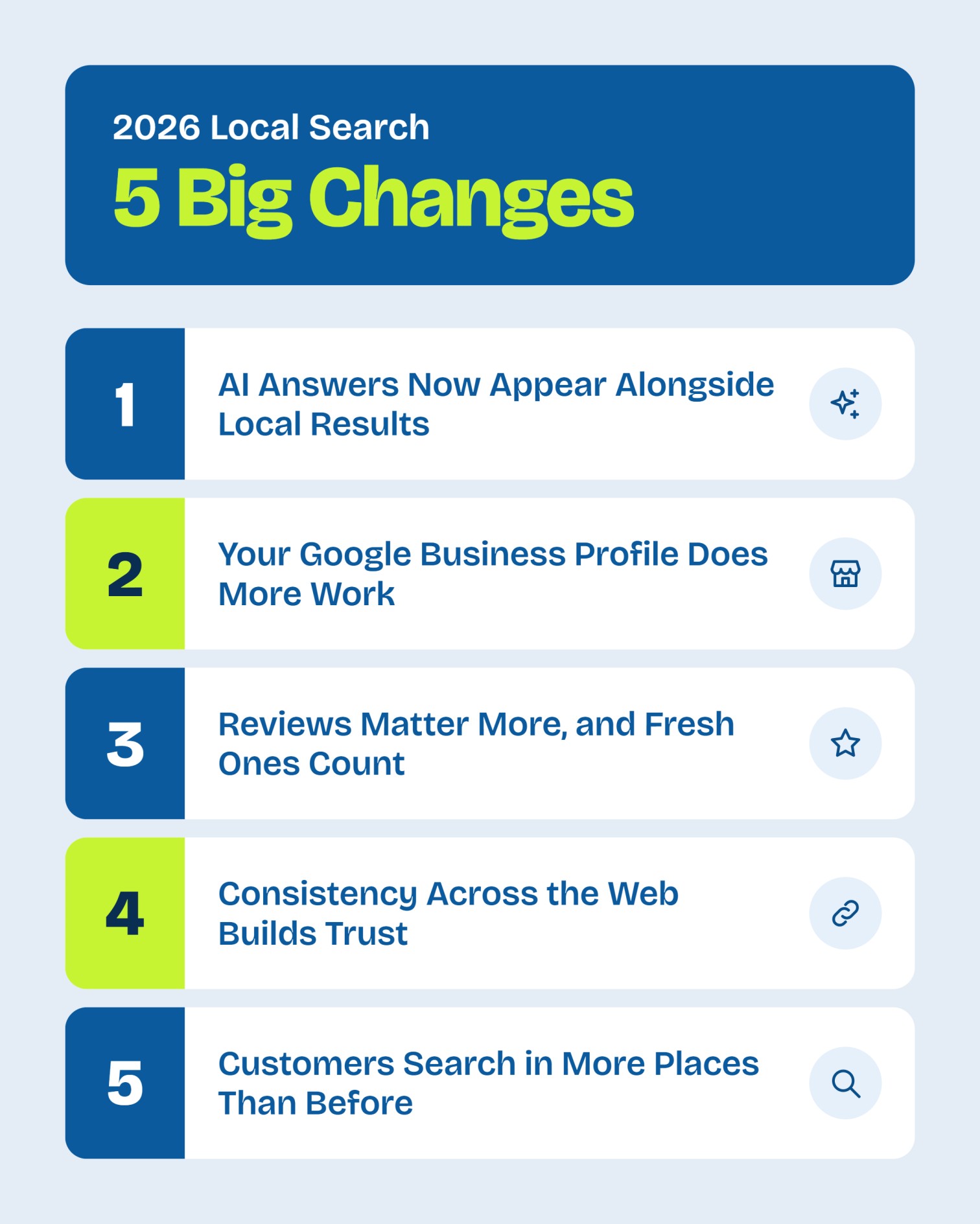
1. AI Answers Now Appear in Local Results
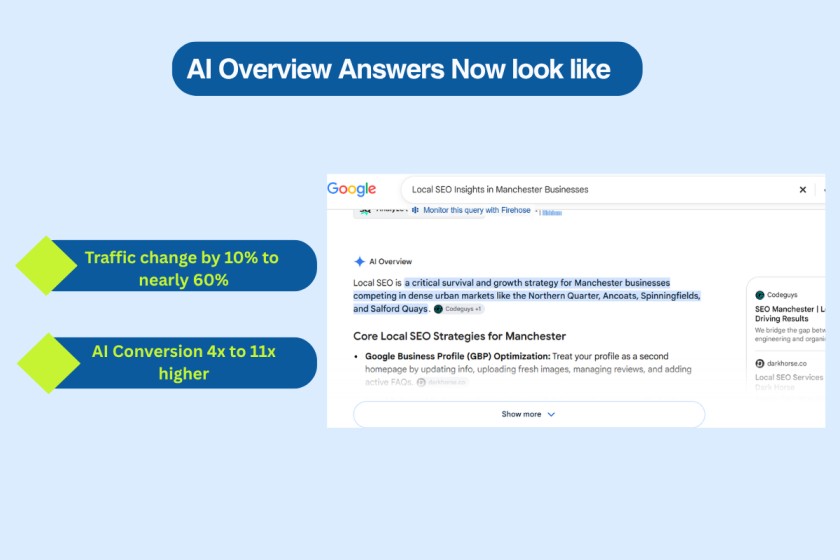
Google now shows AI-written summaries for many searches. Most of them appear on “how to” and “what is” questions. Searches with clear buying intent, such as “boiler repair in Manchester,” still lean on the map results. This means your business can be found in two places: the map listings and the AI answers.
2. Your Google Business Profile Does More Work
Your Google Business Profile is no longer just a listing. Google uses it to rank you on the map, and it also feeds the AI summaries. A profile with missing hours, wrong categories, or no description gives Google less to work with. Treat it as one of your most important pages.
3. Reviews Matter More, and Fresh Ones Count
Reviews are now one of the biggest ranking signals. It is not only about your star rating. Google also looks at how recently you were reviewed and whether you reply. A business with many old reviews and nothing recent can look inactive. A steady flow of new reviews, with a short reply to each one, sends a stronger signal.
4. Consistency Across the Web Builds Trust
Google and AI tools compare what they find about you across different places. If your name, address, phone number, and services differ between your website, your profile, and online directories, they may trust you less. Matching details everywhere help them be sure about who you are and where you work.
5. Customers Search in More Places Than Before
People now find local businesses through Google Search, Google Maps, voice search, and AI chat tools. Many of these searches are conversational, like “Who is a reliable electrician near Didsbury?” Clear service pages that answer these questions in plain words help you show up in more of these places.
What’s Working in Your Industry Right Now
The basics of local search are the same for every business, but each industry has its own habits. Customers look for different things, and trust is built in different ways. Here is what is working for four common service businesses in Manchester.
Dental Practices
- Patients choose a dentist based on trust, so your profile and website need to show real people and real care.
- Add photos of your team, your reception area, and your treatment rooms. Create a separate page for each main treatment, such as check-ups, teeth whitening, implants, and emergency appointments.
- Ask happy patients for reviews often, and reply to every one in a calm, professional way. Never share private patient details in your replies.
Law Firms
- People searching for a solicitor are often stressed, so they look for clarity before anything else.
- Create one clear page for each area of law you cover, such as family law, employment law, or conveyancing.
- Use plain words, explain the process step by step, and show fees where you can.
- Add the name and profile of each solicitor so clients know who they will speak to.
- Reviews also count here, as long as you follow your regulator’s rules on how you ask for and use them.
Plumbing Contractors
- Plumbing searches are often urgent, and customers usually call the first business that looks trustworthy.
- Make sure your phone number, opening hours, and “emergency” availability are easy to find on your profile and website.
- List the areas you cover, such as Chorlton, Salford, or Altrincham, and create a page for each one. Add photos of real jobs, because customers trust them more than stock images.
- If you do gas work, show your Gas Safe registration clearly, since customers look for it.
HVAC Companies
- For heating and cooling work, timing matters. Customers search for boiler repairs in winter and air conditioning in summer, so update your pages and profile posts to match each season.
- Create separate pages for the main services you offer, such as boiler servicing, installations, and air conditioning, and answer common questions on each page. For commercial work, add a short page that explains the types of buildings you serve.
- Reviews that mention the specific job, such as “boiler replaced in one day,” help new customers picture what to expect.
What Surprised Us in This Research
When we looked at the latest 2026 ranking data, three findings stood out. Each one goes against advice many business owners still hear.
Reviews Matter, but They Are Not the Top Ranking Signal
Many owners believe reviews are the key to the map results. They help, and their weight has grown since 2023. Fresh reviews now count for much more than before. But experts still rank one setting above them: your primary Google Business Profile category. If Google does not clearly understand what you do, a strong review score can only do so much. Pick the most accurate main category first, then build your reviews on top of it.
The GBP Service Area Setting Has Zero Ranking Impact
Many service businesses list every nearby town in their service area and hope to rank in each one. Tests show this does not work. Adding or changing service areas did not change rankings. The setting only tells customers where you are willing to travel. Your actual location and your distance from the searcher matter far more. To reach customers in other areas, build service pages for those areas on your website instead.
A Keyword in the Business Name Isn’t a Safe Shortcut
Experts still rate a keyword in the business name as a strong signal. That is why some owners add words like “Manchester Cheap Plumber” to their profile name. But Google’s rules say your name should match your real business name. Stuffing keywords into it is also listed as a negative factor. A boost that can get your profile flagged is a poor bargain. A fair, accurate name and a well-chosen category are the safer choice.
How to Check Your Own Business
You do not need paid tools to see where you stand. Set aside about an hour and work through these six checks.
- Search like a customer. Open Google on your phone and search for your main service plus your area, such as “boiler repair Manchester” or “dentist Chorlton.” Note whether your business appears in the map results, and where. Repeat this for two or three other areas you serve. Your results may change depending on where you are standing, so try a few spots if you can.
- Check your primary category. Open your Google Business Profile and look at your main category. Is it the best match for your core service? A plumber who has “Home improvement” as the main category is giving Google the wrong signal. Check that any extra categories are accurate too.
- Review your name and details. Your business name should match your real name on your signs, invoices, and van. Check that your phone number, address, and website link are correct. Make sure your opening hours are right, including bank holidays.
- Look at your reviews. Count how many reviews you have received in the last three months. Check whether you have replied to the recent ones. If the newest review is six months old, this is the first thing to fix.
- Compare your details across the web. Search for your business name and look at your website, social pages, and any online directories. Do the name, phone number, and address match everywhere? Write down every mismatch and fix them one by one.
- Ask the AI tools. Type a question like “Who is a reliable electrician in Didsbury?” into Google’s AI results, ChatGPT, or Gemini. See whether your business is mentioned. If it is not, note which businesses are, and look at how clear their profiles and websites are.
Keep a simple record of what you find. A short note with today’s date lets you see progress when you check again in three months.
What This Means for You
Local search in 2026 rewards businesses that are clear, accurate, and active. You do not need tricks. You need to get a few basics right and keep them up to date.
Start with the foundations. Choose the right primary category, use your real business name, and keep your hours and contact details correct. These cost nothing and carry more weight than most owners expect.
Next, build a steady habit around reviews. Ask every happy customer, and reply to each review you receive. A few new reviews each month help more than a big burst once a year.
Then give customers and AI tools clear information to work with. Create a page for each main service and each area you cover, and write in plain words. Do not rely on the service area setting in your profile to get you found in other towns.
Finally, avoid shortcuts such as keyword-stuffed names. They may look tempting, but they put your listing at risk.
If you do only one thing this week, run the six checks above and fix the first problem you find. Small, steady improvements add up, and many of your competitors are still ignoring them.